
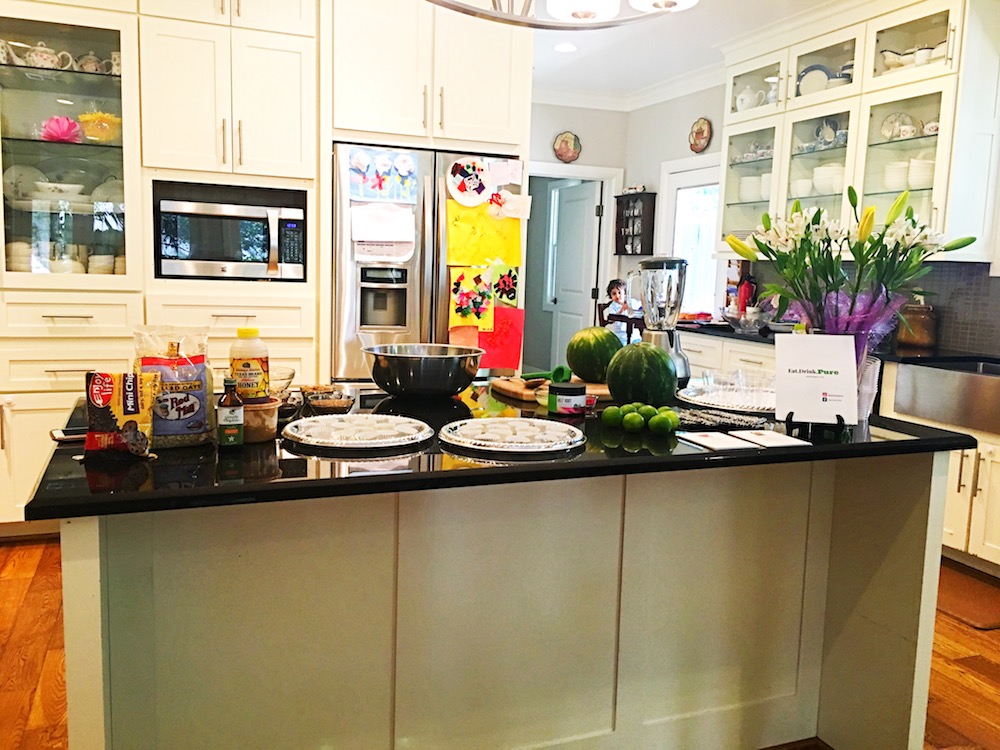
Ramadan is barely a month away, and I am panicking. I have plans to eat healthier this Ramadan, and it really helped to share more nutritious recipes to reinforce my resolve this past weekend. My dear friend Sameera hosted a talk and cooking demonstration in honor of the fast-approaching month, and I had the pleasure of speaking to a group of ladies on using this month as a means to jumpstart our road to a healthier lifestyle. After the talk, we had fun making a couple of recipes. I offered these as alternatives to old, unhealthy favorites, like Watermelon Juice in place of Rooh Afza and Granola Bites for sahoor.
We often use fasting during the day as an excuse to overeat at night and end up nullifying the benefits that Ramadan is meant to bring us. That is why I spoke about the need to use this month to detoxify our bodies as well as our souls.
A Little Background
Ramadan is the ninth month of the Islamic lunar calendar. It is the month when Muslims all around the world fast from dawn to dusk. It is not only food that one forgoes during those hours, but also sexual relations, as well as any negative feelings or emotions. Basically, it is a test of patience. It is a time when one focuses on the body’s spiritual needs and denies its physical needs.
Here Are My Suggestions For A Healthier Ramadan
Meal Prep
Meal prepping is becoming extremely popular these days, with more and more people jumping on the health and wellness bandwagon. Prepping is half the battle won when it comes to avoiding processed junk. Prepping ahead will save you from running out to the grocery store and grabbing the first thing you see. Remember, when you shop hungry, you risk buying more than you need, and that, too, whatever you can get your hands on. Some of the best things to meal prep are chutneys, samosas, smoothie ingredients, and granola bites ( excellent for sahoor, the pre-dawn meal, or just as a pick-me-up before perhaps dashing off to taraweeh, the voluntary night prayer).
Make Suhoor A Priority
Many people can’t stomach a pre-dawn meal, but if we want to eat healthier at iftar, it is essential to nourish our bodies at sahoor. This will ensure a productive day and help prevent blood sugar dips and fatigue. If that isn’t motivation enough, remember, it’s sunnah!
The Prophet (pbuh) has said:
Take suhoor as there is blessing in it
Eat Whole, Nutrient-dense Foods

Foods such as dates, honey, barley, and squash are all considered superfoods today. These were some of the foods recommended by the Prophet (pbuh) over 1400 years ago for good reason. Whole, nutrient-dense foods will give us the energy we need to last the fourteen-plus hours of fasting we have here in North America. Eating nutritiously will also prevent the gorging session we are likely to indulge in at iftar. Make sure to include fiber-rich foods such as oatmeal, barley, apples, and avocados, among others, at suhoor. Fiber-rich foods are known to keep you feeling full longer.
WANT TO SAVE THIS RECIPE?
Limit Deep Fried Foods
This may be highly challenging for those of us who originate from the Indian Subcontinent, as Ramadan is considered a free pass to eat as many Pakoras (gram flour fritters) and Samosas as our hearts desire. However, it is these fried foods that increase the risk of heart disease and type 2 diabetes. A study conducted by Leah Cahill of Harvard School of Public Health and An Pan of the National University of Singapore's Saw Swee Hock School of Public Health concluded that the risk increased with the frequency of fried food consumption. For example, participants who ate fried foods 4-6 times per week had a 39% increased risk, compared to a 55% increase among those who ate fried foods all 7 days of the week. Now imagine what it does to the body if we eat fried foods every single day for a whole month.
Hydrate
Hydration is essential, and one should aim for at least 10 glasses of fluid a day. Although best, water need not be the only source. Milk, soups, vegetables, and fruits are also excellent sources. Limit coffee and tea as they contain caffeine, which dehydrates the body.

Shireen Hakim, RD suggests 2 cups at sahoor, two at iftar, two after Maghreb, a water bottle at taraweeh, and 2 cups before bed.
Give Green Tea A Try
This may sound contradictory, since green tea contains caffeine, but the pros far outweigh the cons. To have it after iftar can be extremely helpful. Green tea contains Epigallocatechin gallate (EGCG), which, according to a study from Japan, may offset the signs of mental and physical fatigue. EGCG has also been shown to improve insulin sensitivity, helping prevent sugar spikes and crashes that lead to irritability and cravings for unhealthy foods.
Avoid Overeating
This may be by far the toughest step, but we must remember that gluttony is discouraged in our deen. The Prophet (pbuh) has said in Ahmed, Thirmidi:
It is enough for the son of Adam to have just morsels that he can keep his back upright with. But if he must then 1/3 for food, 1/3 for water, 1/3 for air.
Granted, after a whole day of fasting, it is almost impossible to stop yourself from gorging at iftar, but remember that the disadvantages of doing so are many. Bloating, lethargy, and acid reflux are the most immediate. Make a conscious effort to listen to your body and stop at the first sign of fullness, especially when eating out and at parties.
So there you have it. I hope you find benefit in following these tips during Ramadan and can make it the most productive and healthy one yet. I pray that the healthy eating we do in this blessed month gives us the jumpstart we need to live a healthier and more balanced lifestyle long after Ramadan has passed.
Share this article with friends and family, you will be doing your good deed for the day!
Leave a Reply